MA | LPN | Phlebotomy
Medical Terminology - Word Structure
Understanding Medical Word Structure
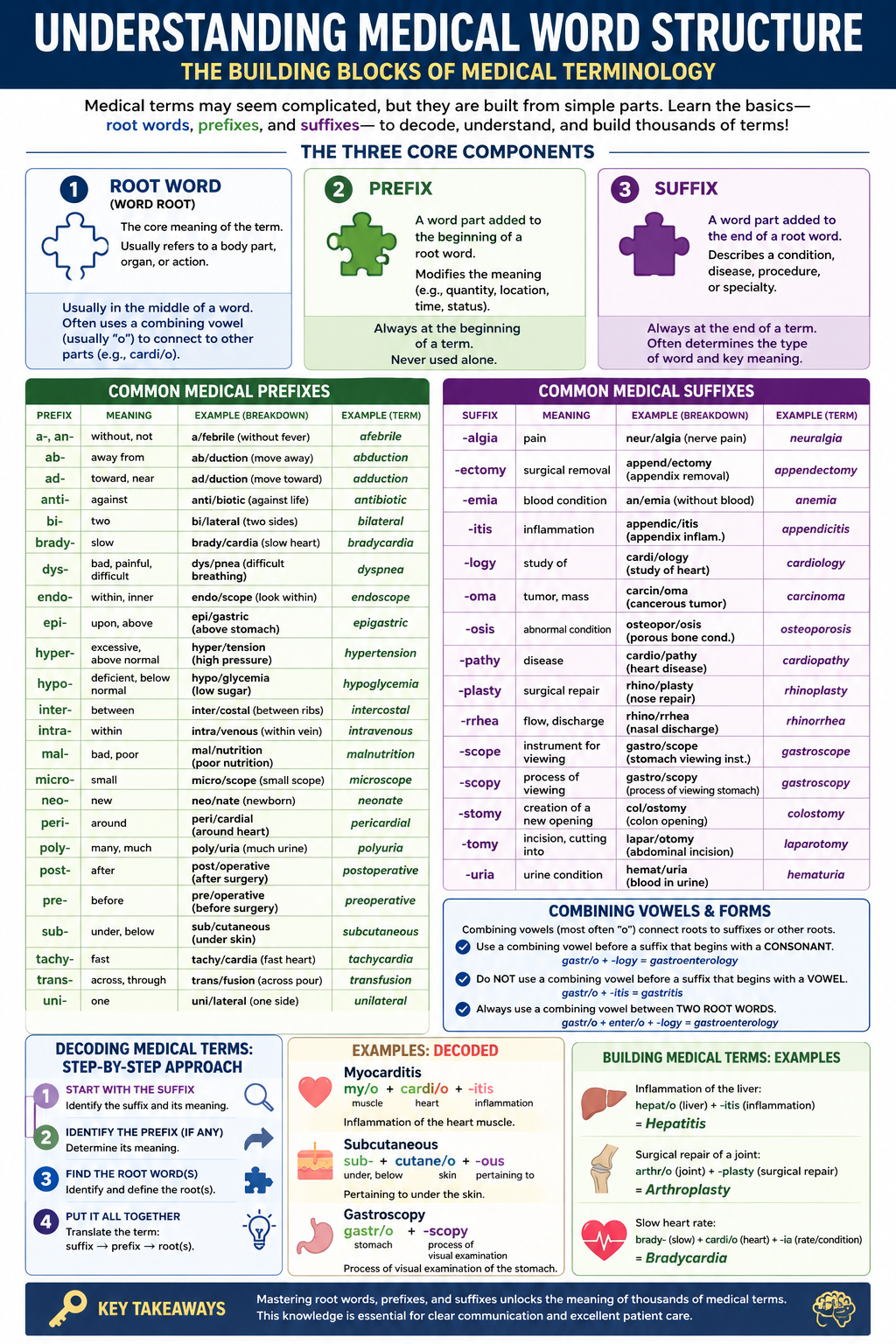
Medical terminology can seem daunting at first, but it is built on a logical system of word parts. By understanding these basic components – root words, prefixes, and suffixes – you can decipher thousands of medical terms. This foundational knowledge is crucial for accurately reading, writing, and speaking in healthcare.
The Three Core Components
Every medical term can typically be broken down into one or more of three basic components:
- Root Word (Word Root): The core meaning of the term.
- Prefix: A word part added to the beginning of a root word to modify its meaning.
- Suffix: A word part added to the end of a root word to modify its meaning.
1. Root Words
The root word is the fundamental part of a medical term that contains its primary meaning. It often refers to a body part, organ, or action. While some terms have only a root and a suffix, most complex terms include a prefix, one or more roots, and a suffix.
- Location: Usually located in the middle of a word.
- Combining Form: When a root word needs to be joined with another root word or a suffix that begins with a consonant, a combining vowel (most commonly 'o', but sometimes 'i' or 'e') is added to the root. This creates a combining form (e.g.,
cardi/o). The combining vowel makes the term easier to pronounce.
Examples of Root Words:
- Cardi/o: Heart (e.g., cardiology)
- Gastr/o: Stomach (e.g., gastritis)
- Hepat/o: Liver (e.g., hepatitis)
- Nephr/o: Kidney (e.g., nephrology)
- Oste/o: Bone (e.g., osteoporosis)
- Pulmon/o: Lung (e.g., pulmonary)
- Derm/o, Dermat/o: Skin (e.g., dermatitis)
- Neur/o: Nerve (e.g., neurology)
- Hem/o, Hemat/o: Blood (e.g., hematology)
2. Prefixes
A prefix is a word part that comes before a root word. It modifies the meaning of the root by indicating quantity, location, time, color, or status.
- Location: Always at the beginning of a term.
- Never used alone: Prefixes must always be attached to a root word.
Common Medical Prefixes and Their Meanings:
| Prefix | Meaning | Example (Breakdown) | Example (Term) |
|---|---|---|---|
| a-, an- | without, not | a/febrile (without fever) | afebrile |
| ab- | away from | ab/duction (move away) | abduction |
| ad- | toward, near | ad/duction (move toward) | adduction |
| anti- | against | anti/biotic (against life) | antibiotic |
| bi- | two | bi/lateral (two sides) | bilateral |
| brady- | slow | brady/cardia (slow heart) | bradycardia |
| dys- | bad, painful, difficult | dys/pnea (difficult breathing) | dyspnea |
| endo- | within, inner | endo/scope (look within) | endoscope |
| epi- | upon, above | epi/gastric (above stomach) | epigastric |
| hyper- | excessive, above normal | hyper/tension (high pressure) | hypertension |
| hypo- | deficient, below normal | hypo/glycemia (low sugar) | hypoglycemia |
| inter- | between | inter/costal (between ribs) | intercostal |
| intra- | within | intra/venous (within vein) | intravenous |
| mal- | bad, poor | mal/nutrition (poor nutrition) | malnutrition |
| micro- | small | micro/scope (small scope) | microscope |
| neo- | new | neo/nate (newborn) | neonate |
| peri- | around | peri/cardial (around heart) | pericardial |
| poly- | many, much | poly/uria (much urine) | polyuria |
| post- | after | post/operative (after surgery) | postoperative |
| pre- | before | pre/operative (before surgery) | preoperative |
| sub- | under, below | sub/cutaneous (under skin) | subcutaneous |
| tachy- | fast | tachy/cardia (fast heart) | tachycardia |
| trans- | across, through | trans/fusion (across pour) | transfusion |
| uni- | one | uni/lateral (one side) | unilateral |
3. Suffixes
A suffix is a word part that comes after a root word. It describes a condition, disease, procedure, or specialty.
- Location: Always at the end of a term.
- Key to Meaning: Often determines the type of word (e.g., a noun, adjective, or verb) and is usually the first part of a medical term you interpret when analyzing it.
Common Medical Suffixes and Their Meanings:
| Suffix | Meaning | Example (Breakdown) | Example (Term) |
|---|---|---|---|
| -algia | pain | neur/algia (nerve pain) | neuralgia |
| -ectomy | surgical removal | append/ectomy (appendix removal) | appendectomy |
| -emia | blood condition | an/emia (without blood) | anemia |
| -itis | inflammation | appendic/itis (appendix inflam.) | appendicitis |
| -logy | study of | cardi/ology (study of heart) | cardiology |
| -oma | tumor, mass | carcin/oma (cancerous tumor) | carcinoma |
| -osis | abnormal condition | osteopor/osis (porous bone cond.) | osteoporosis |
| -pathy | disease | cardio/pathy (heart disease) | cardiopathy |
| -plasty | surgical repair | rhino/plasty (nose repair) | rhinoplasty |
| -rrhea | flow, discharge | rhino/rrhea (nasal discharge) | rhinorrhea |
| -scope | instrument for viewing | gastro/scope (stomach viewing inst.) | gastroscope |
| -scopy | process of viewing | gastro/scopy (process of viewing stomach) | gastroscopy |
| -stomy | creation of a new opening | col/ostomy (colon opening) | colostomy |
| -tomy | incision, cutting into | lapar/otomy (abdominal incision) | laparotomy |
| -uria | urine condition | hemat/uria (blood in urine) | hematuria |
Combining Vowels and Forms
As mentioned, combining vowels (most often 'o') are used to connect a root word to a suffix or another root word, especially if the suffix or subsequent root begins with a consonant. This creates a combining form (e.g., gastr/o from gastr).
Rules for Combining Vowels:
- A combining vowel is used when connecting a root to a suffix that begins with a consonant. (e.g.,
gastr/o + -logy = gastroenterology) - A combining vowel is NOT used when connecting a root to a suffix that begins with a vowel. (e.g.,
gastr/o + -itis = gastritis) - A combining vowel is always used when connecting two root words. (e.g.,
gastr/o + enter/o + -logy = gastroenterology)
Decoding Medical Terms: Step-by-Step Approach
To understand a complex medical term, break it down and interpret it in a specific order:
- Start with the Suffix: Identify the suffix first and determine its meaning. This usually tells you what kind of term it is (condition, procedure, etc.).
- Identify the Prefix (if any): If there's a prefix, determine its meaning. This modifies the core meaning.
- Find the Root Word(s): Identify the root word(s) and their meanings. These provide the main subject of the term.
- Put it all together: Mentally (or literally) translate the meaning by starting with the suffix, then the prefix, and finally the root word(s).
Example 1: Myocarditis
- -itis: inflammation
- my/o: muscle
- cardi/o: heart
- Translation: Inflammation of the heart muscle.
Example 2: Subcutaneous
- -ous: pertaining to
- sub-: under, below
- cutane/o: skin
- Translation: Pertaining to under the skin.
Example 3: Gastroscopy
- -scopy: process of visual examination
- gastr/o: stomach
- Translation: Process of visual examination of the stomach.
Building Medical Terms
Just as you can break down terms, you can also build them by combining the appropriate parts:
-
Inflammation of the liver:
- Liver: hepat/o
- Inflammation: -itis
- Term: Hepatitis
-
Surgical repair of a joint:
- Joint: arthr/o
- Surgical repair: -plasty
- Term: Arthroplasty
-
Slow heart rate:
- Slow: brady-
- Heart: cardi/o
- Rate/condition: -ia (implied in this context or often just the root combined with brady-)
- Term: Bradycardia
Key Takeaways
Mastering the structure of medical words is fundamental to success in healthcare. By diligently studying root words, prefixes, and suffixes, you will develop the ability to understand and correctly use medical terminology, which is essential for effective communication and patient care.
Ready to Go Deeper?
This is just a sample of what Allied Mastery offers. Sign up to unlock our full library, create custom quizzes, track your performance, and more.